
Delhi's 24-hour average air quality index (AQI) stood at 407 at 4 pm.

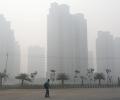
The smog reduced the visibility to merely 300 meters in the morning affecting traffic, an official of the India Meteorological Department said.
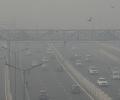
Delhi's 24-hour average air quality index (AQI) stood at 248 on Saturday.

The city's 24-hour average AQI was recorded in the 'poor' category at 265 on Saturday as residents flouted the ban on firecrackers in parts of the national capital ahead of Diwali, according to Central Pollution Control Board's (CPCB) data.
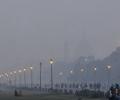
Pollution levels in Delhi during the Diwali period are likely to remain in the higher end of the 'very poor' category in the absence of emissions due to fireworks, the Ministry of Earth Sciences' air quality monitor, SAFAR said.

The poisonous haze has been causing significant problems for people with existing respiratory issues, according to doctors.
Acentral panel directed authorities to ban the plying of 4-wheeled diesel LMVs in Delhi and adjoining NCR districts and the entry of trucks into the capital.

Delhi's air quality was again in the severe category with the 24-hour average AQI recorded at 403 after remaining in the 'very poor' category till Tuesday morning, when the AQI was recorded at 396.

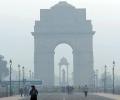
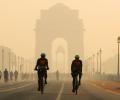
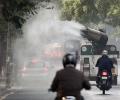
A thick layer of toxic smog enveloped the national capital on Saturday as air quality deteriorated sharply, prompting the Commission for Air Quality Management (CAQM) to invoke the strictest curbs under Stage IV of the Graded Response Action Plan (GRAP) across Delhi-NCR.

The Supreme Court on Wednesday asked the Commission for Air Quality Management (CAQM) to consider directing schools in Delhi-NCR to postpone open air sports competitions planned in November and December to 'safer months' keeping in mind air pollution levels.

A bench of Justices Abhay S Oka, Ahsanuddin Amanulllah and Augustine George Masih said the Commission for Air Quality Management in National Capital Region and Adjoining Areas Act of 2021 (CAQM Act) was enacted without creating required machinery for implementing the provision to curb air pollution.

The overall Air Quality Index (AQI) of Delhi stood at 398 at 11 am, worsening from 357 at 4 pm on Friday. It was 354 on Thursday, 271 on Wednesday, 302 on Tuesday and 312 on Monday (Diwali).

The Supreme Court on Wednesday rapped the Haryana and Punjab governments over non-prosecution of violators found guilty of stubble burning and summoned the state chief secretaries to appear before it on October 23 and submit. an explanation.

The Supreme Court has permitted the sale and bursting of green crackers in Delhi-NCR for Diwali, relaxing the ban on green firecrackers as a temporary measure from October 18 to 21. The court has asked pollution control boards to monitor pollution levels and file reports. The order also includes measures to prevent the sale of non-compliant crackers.

Mundane as it may seem, this is in some ways a metaphor for the challenges facing the nation, argue Arvind Subramanian and Devesh Kapur in their new book, A Sixth Of Humanity.

The Supreme Court is considering relaxing the ban on firecrackers in Delhi-NCR ahead of Diwali, citing practical concerns and the need to balance environmental and livelihood interests.
'Most pollution boards across the country have unused funds. There is practically no reason why pollution should not be a political priority.'

Violation of the provisions entails a punishment of a jail term of up to five years or with fine up to Rs one crore or with both.

The minimum temperature in the capital dropped to 9.6 degrees Celsius, three notches below normal and the lowest this season so far. The maximum is likely to settle around 27 degrees Celsius, the India Meteorological Department said.

Delhi's air quality improved for the second consecutive day on Thursday, with the Air Quality Index (AQI) recorded in the "moderate" category at 165. This marks a significant improvement from the "poor" category recorded on Tuesday. Several restrictions imposed under Stage 4 of the Graded Response Action Plan (GRAP) were lifted, but some restrictions under Stage 2 remain in place. The Decision Support System (DSS) has not been updated since Friday, with technical difficulties hindering the update of data for the last six days.
Violation of the provisions entails a punishment of a jail term up to five years or with fine up to Rs 1 crore or with both, the ordinance released by the Ministry of Law and Justice on Thursday said.
The Supreme Court on Friday directed the Centre and the states in the National Capital Region (NCR) to implement the orders of the panel on air quality management to curb air pollution while ruing that some sections of the media have 'portrayed' it as a 'villain' which wants to close down schools in New Delhi.

Pollution levels in the national capital entered the "severe" zone for the first time this season on Thursday, with scientists warning of a further spike over the next two weeks.

Delhi's air quality deteriorated significantly on Monday, with areas like Dwarka, Mundka and Najafgarh recording an AQI of 500, the worst this season. The city's overall AQI reached 491, triggering the implementation of the Graded Response Action Plan (GRAP) Stage-IV restrictions in Delhi-NCR. Doctors warned of health risks, urging people to wear N95 masks and avoid outdoor activities. The Supreme Court questioned the Delhi government on its anti-pollution measures and warned against scaling down preventive measures without its permission. Delhi Chief Minister Atishi accused the BJP-led central government of political maneuvering while neglecting stubble burning in states it governs. Meanwhile, the city enforced stricter pollution control measures, including a ban on truck entry and suspension of construction activities. Air purifier sales surged, reflecting the public's concern over the severe air pollution.

The Delhi government has requested the Centre's air quality panel to suspend the fuel ban on older vehicles, citing implementation challenges and public discontent. The government is also seeking solutions to restrictions on end-of-life vehicles.
A special bench headed by Chief Justice N V Ramana, in an interim order uploaded Wednesday night, also directed the Commission for Air Quality Management in the NCR and Adjoining Areas to 'commission a scientific study of air quality based on available data of previous years bearing upon recorded levels of air pollution'.

The increase in stubble burning has kicked off a political slugfest, with Union Environment Minister Bhupender Yadav on Wednesday saying that there had been a 19 per cent rise in farm fires over 2021 in Punjab and that the Aam Aadmi Party had turned the national capital into a gas chamber.
It also asked the governments of Punjab and Haryana to take immediate stringent actions to curb stubble burning and authorities in Delhi-NCR to strictly check biomass burning.

The Delhi government has banned construction and demolition activities in the city till November 21.
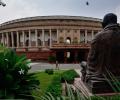
Opposition is expected to raise these issues in the session beginning July 19. It will be the first session of parliament after the outbreak of the devastating second wave of Covid.

Pollution is biggest reason behind the spike in COVID-19 cases in Delhi. We had situation under control until October 20, the CM said.

The court was informed that the commission for air quality management will start functioning from today.

Stating that 'we cannot...infuse creativity in your bureaucracy', the apex court warned it will have to do something extraordinary if the authorities failed to control pollution.
The Centre on Monday earmarked a separate Rs 2,217 crore for 42 urban centres to tackle air pollution and announced the much-awaited voluntary vehicle scrapping policy to phase out old and polluting vehicles, even as it shrunk the budgetary allocation for the environment ministry from the last fiscal by nearly eight percent. Union Finance Minister Nirmala Sitharaman, in her budget speech for 2021-22, announced a total of Rs 2869.93 crore for the ministry, Rs 230 crore less than the last fiscal. Officials said the outlay has been lesser this time as the economy is recovering from the COVID-19 pandemic.

The top court also asked the state governments of Punjab and Haryana to pursue the farmers for two weeks not to do stubble burning.

In India, air pollution is most severe in the Indo-Gangetic Plain (northern India), where topography and meteorology concentrate pollution from energy, mobility, industry, agriculture, and other activities, the researchers said.

The session will begin with the address of the President to the joint sitting of the two Houses on Friday morning followed by the presentation of the Union Budget on February 1.

Farmers said the agenda of the meeting should also include amendments to be made and notified in the Commission for the Air Quality Management in National Capital Region and Adjoining Areas Ordinance, 2020 to exclude farmers from its penal provisions.

The Samyukt Kisan Morcha wrote an open letter to Prime Minister Narendra Modi on Sunday seeking immediate resumption of talks with the government over their six demands, including a law guaranteeing minimum support price (MSP) for all farmers.
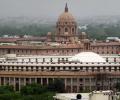
The Opposition on its part wants to corner the government by raising issues like alleged shortcomings in the healthcare system during the second wave of the coronavirus pandemic and the distribution of Covid vaccines to states.
 © 2026 Rediff.com - Advertise with us - Disclaimer - Privacy Policy - Sitemap - Feedback - About us - Terms of use - Grievances